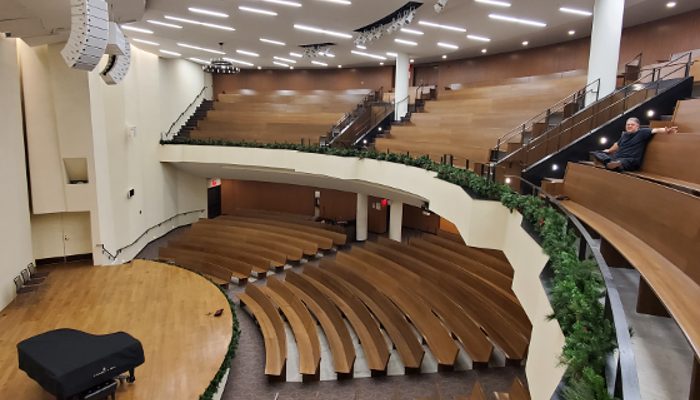
Controlling amplified sound to reduce reverberation and ensure intelligibility is one of the major challenges faced by houses of worship all over the world, writes Dom Harter.
When you talk to anyone about the problems they face with worship audio, reverberation is always near the top of the list. The main issue is that most houses of worship have been designed as large, high-ceilinged spaces, filled with reflective surfaces. The result can be beautiful to look at, but highly reverberant. While this produces great sound for unamplified music and speech, as soon as you add in a conventional sound system, the amount of extra energy bouncing around the venue severely reduces the intelligibility.
Over the years, several methods have been used to try and tackle this issue. One solution has been to throw more loudspeakers at the problem. The logic behind this is adding in more direct sources will overpower the echoes and reflections heard by members of the congregation and therefore boost intelligibility. However, this succeeds in adding a lot more acoustic energy into an already reverberant space.
More recently, beam steering has been adopted as a popular solution. This can be achieved either electronically or manually, and essentially calls on column loudspeakers to create beams of sound that can be directed away from the walls and ceilings so that more of the energy is focused on the congregation. However, these systems can also produce unwanted vertical sidelobes in the audio band, adding to the reverberant energy and consequently impacting intelligibility.
A third approach is optimisation. This is a technique that was created by Martin Audio with the launch of the pioneering O-Line micro line array back in 2007 – a solution that is still popular in worship circles today. Building on this came the MLA family, a controllable loudspeaker series that was developed so that a touring PA could be tuned to a different room every night. The system ensured even sound levels across a venue while making sure that the speakers were avoiding reflective spots such as balconies. The ability of FIR filters to manipulate magnitude and phase of the audio signal independently of each other is a key component in how this is achieved.
The ability to consider the whole space when controlling audio is an important consideration for many worship audio designers. So it is no surprise that these optimisation capabilities caught the attention of the international worship community with the MLA Compact and MLA Mini proving to be a popular option in the US.
The latest iteration of optimisation is based around the constant upgrades and enhancements to the DISPLAY 2 software combined with the realisation that the DSP technology didn’t necessarily need to be inside the loudspeakers. Moving the processing power into the iKON family of amplifiers, with the launch of the Wavefront Precision series in 2017, ensured that optimisation could now be a feasible option for more installations. By putting the processing in the amplifiers, the solution became scalable, ensuring that houses of worship can consider both the desired end result and the available budget.
This scalable resolution concept means that users can choose the number of amplifiers they require for the solution, and increase this over time as more budget becomes available if they wish to enhance the overall performance. This means a house of worship could get immediate acoustic benefits from an installation at the minimum resolution, and then invest again when it has more budget to increase the number of amplifiers and further improve the acoustic environment. Equally, if the project didn’t require the highest resolution of the top-end system, this doesn’t need to be purchased and funds can be allocated elsewhere.
Scalable resolution is ultimately about reducing the barriers to get a much better result for everyone. And then allowing the user to decide how much electronics both the application or indeed the client can afford and tailor the response of the PA to it. This flexibility has been one of the main reasons for its popularity in the worship community.
Whichever option a house of worship goes for, it is essential that if you are adding amplified sound into a reverberant space you have some way of controlling it. Making sure that your acoustic energy is being directed towards the congregation will result in a better comprehension of the message that you are trying to spread.
Dom Harter is the managing director of Martin Audio. For more information, please visit www.martin-audio.com.