Danish waste management company Kara/Noveren set out to replace two furnaces with a state-of-the-art waste-to-energy incineration line in 2011. Three years later the incineration line, or more popularly referred to as The Energy Tower, stands tall on the skyline of the Danish city of Roskilde.
Increasing demands to reduce carbon emissions from fossil fuels calls for alternative energy production, and implementing a modern facility will allow Kara/Noveren to use the energy resources from residual waste that cannot otherwise be recycled. In line with this Kara/Noveren vision was for The Energy Tower to become a new Danish landmark and naturally they wanted an energy efficient lighting solution to go with it. They envisioned a structure with the ability to communicate and relay messages of sustainable energy to the public. Located only a few hundred metres from one of the major inroads to the Danish Capital of Copenhagen, it has a huge reach with potentially thousands of spectators on a daily basis.
The Energy Tower was designed by Dutch architect and expert in sustainable design Erick Van Egeraat, who brought in Danish lighting architect Gunver Hansen to identify and implement the most optimal lighting solution. The lighting solution had to be able to reproduce the lighting concept created by Van Egeraat and all fixtures should be individually controllable to give the building a dynamic expression. It was also crucial that the fixtures would be able to illuminate the relatively difficult projection surface, which was dark and very diverse. At the same time the lighting should be bright and powerful enough to be seen from a distance. Finally, of course there was also a desire for low power consumption.
Ultimately, Martin Professional’s Exterior range fixtures were chosen for the project due to their size, durability, and colour reproduction capabilities.
From flicker to flame
Van Egeraat’s vision for the lighting was for it to be an aesthetic contribution to The Energy Tower as a new landmark, and that it should signal the processes that take place inside of the tower and portray the combustion and energy making process.
“At night the backlight perforated façade transforms the incinerator into a gently glowing beacon – a symbol of the plant’s energy production. Several times an hour a spark of light will gradually grow into a burning flame that lights up the entire building. When the metaphorical fire ceases, the building falls back into a state of burning embers,’ explains Van Egeraat.
The art of precision
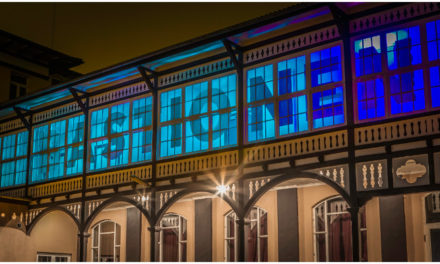
According to Hansen this was one of the more challenging projects of her career. The structure itself consists of a framing grid built around the new chimney. An amber-coloured aluminium plating is mounted onto the grid to form the exterior façade of the tower. The fixtures are mounted inside on the grid between the outer façade and the façade of the inner building, and the fixtures project onto the inner façade which is visible at night through the laser-cut circular openings of the outer façade. Factors that had to be taken into consideration were that the distance between the exterior façade and the interior projection surface varies across the entire structure, therefore each fixture had to be placed carefully so the colours would mix correctly and the output would be even. Also, as the direct view into the LEDs in the fixtures had to be avoided, a number of the projectors had to be screened off with a specially designed grid.
The Energy Tower has been submitted for the Danish Lighting Award 2014 and part of the magic of Kara/Noveren’s new Energy Tower is its ability to alter its appearance with future lighting designs for special events, and that the lighting concept sends the message of waste-to-energy to spectators. It is an important message with global relevance.
“We’re very pleased with the end result. The many creative possibilities for changing light colour and light patterns on the Energy Tower’s façades work amazingly. I think we have succeeded in creating a shining Energy Tower, that is a fascinating and magical landmark on the dark Roskilde night sky,’ wraps up Hansen.