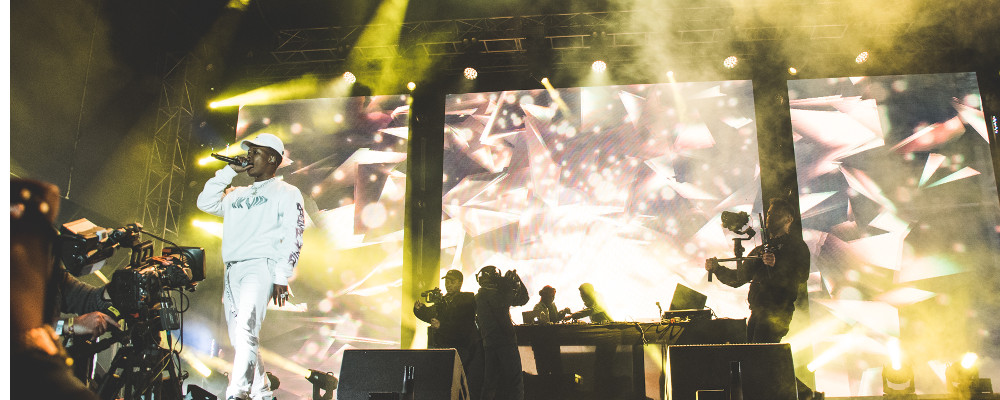
Returning to the Cloof Wine Estate in Darling for its 14th edition, and with a diverse international line up including The 1975, Russ, Tash Sultana and Nasty C, Rocking the Daisies is one of South Africa’s biggest music festivals.
Cape Town-based production company Bad Weather delivered all aspects of the festival’s live video, providing a masterclass in how innovative technologies can enhance the festival experience. Powered end-to-end by a Blackmagic Design workflow, featuring Blackmagic URSA Broadcast and ATEM Constellation 8K technologies, we caught up with creative director Jonathan Bandli to get the low-down.
This was not the first time Bad Weather has delivered the live production of Rocking the Daisies (RTD), but it was, in fact, only the second outing for its new 4K PPU solution, the first being a gaming tournament held at ComicCon South Africa in September this year.
Jonathan says: “We came to RTD straight off the back of ComicCon with little to no prep between the shows. but we’d provisioned for that when we configured the setup, and we had confidence the gear would work in the way we intended first time. It’s also a testament to how flexible Blackmagic’s video hardware is.”
He continues, “Previously we would hire in kit, so this was our first investment in a system that we’d own ourselves. The motivation for that was driven by our need for something reliable, yet affordable. The only way to ensure it met our needs, and supported our creative vision, was to design and build it from scratch.
“The solution had to integrate into our existing workflows, which includes media server work, Notch real-time rendered motion graphics and effects, and our full visual design solutions.”
ETECH first covered Bad Weather’s innovative use of Notch software in a feature of real-time graphics engines published in October. In that feature, Bad Weather co-director Andrew Bosman outlined the practical and creative implications of the Notch real time rendering engine as follows: “Everything the camera picks up is fed through a widget designer into Notch and then – once you’ve set the parameters of your canvas – that content is rendered and displayed in real time. You can also link the data from the camera to a lighting console, though: for example, in MA 3D you can link the data to MA consoles and have lights follow performers.”
Jonathan continues: “Bringing this final component (the portable production unit) in house means that we can now provide our clients with a full service solution, ensuring that we are not only consistent in the quality of our productions, but that we also continue to innovate.
“Bringing this final component (the portable production unit) in house means that we can now provide our clients with a full service solution, ensuring that we are not only consistent in the quality of our productions, but that we also continue to innovate.”
Jonathan Bandli, creative director of Bad Weather
“Also, having a 4K-capable workflow was key for us as it ensures that we have a competitive advantage in the market, a higher quality product for our clients and a solid investment for the future.”
The new PPU system features the Atem Constellation switcher as well as Ursa Broadcast camera chains.
“We used the URSA Broadcast for acquisition,” Jonathan says. “At front of house we had a single camera with a very long lens and a supplementary Micro Studio Camera 4K locked off just next to the sound desk. In front of the stage, meanwhile, we had a jib-mounted Ursa Broadcast, and another on a dolly. On stage was a roaming camera op and a micro camera positioned on a drum riser or DJ booth for additional cutaways.”
According to Jonathan, the image quality of these cameras was something that the festival had never experienced before. “The cameras performed perfectly in low light and they handled the dynamic range of a large stage set with changing light and heavy contrast so elegantly. Our solution has completely changed the perception of the organisers’ previous experience with live camera systems,” he adds.
The main stage featured three central LED screens making up one canvas, with the middle screen being a 6×6 meter square and each outer screen measuring 3.6 metres wide by 6 meters high. There were, additionally, two 5.4m x 8.4m IMAGs stage left and right.
“With both side screens essentially being portrait, we had to be careful of how we framed our shots, making sure that everything was centred,” Jonathan reveals.
The production desk was located 60 meters away from the stage. “We had just the one rack, and at the top was a Teranex Express. We recorded the entire festival in 2160p24, but that wasn’t suitable for some of the other screens around the site, so we downscaled everything to 1080i using the Teranex,” he explains.
Relying on the Mini Converter Optical Fibre 12G, each camera channel sent a signal back over multimode fibre to an Atem Talkback Converter 4K racked in the PPU setup. Converted back to SDI, those signals were then patched to an Atem Constellation 8K switcher and vision-mixed using an Atem 1 M/E Advanced Panel.
“One of the main factors on choosing to invest in this switcher is that we have standard conversions on every input,” Jonathan reflects. “It is so often an issue on live events with external sources, and so it just gives us peace of mind knowing that we can make any show happen. With all those inputs and outputs it lets us take on any project with confidence, and – as it is the heart of the system – it made sense for us to invest in the best unit in the Atem line up, giving us future expandability with 8K and a system that will work hard for many years to come.”
PULL-QUOTE:
“One of the main factors on choosing to invest in this switcher is that we have standard conversions on every input. It is so often an issue on live events with external sources, and so it just gives us peace of mind knowing that we can make any show happen. With all those inputs and outputs it lets us take on any project with confidence, and – as it is the heart of the system – it made sense for us to invest in the best unit in the Atem line up, giving us future expandability with 8K and a system that will work hard for many years to come.”
Jonathan Bandli, creative director of Bad Weather