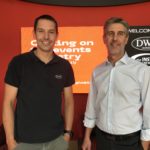
The story of Viva Afrika is one that inspires those who came from humble beginnings; who wish to make a name for themselves through hard work despite the challenges. Indeed, there are many companies in South Africa that supply all manner of technical equipment to our market but very few have taken the path Viva Afrika has. Their products are ubiquitous, despite their low-profile status, and to top it all off, they have built their foundation on manufacturing local products for local people and not just by bringing in a handful of expensive international brands that compete in a very competitive sphere.
Today Viva Afrika is distributor of Hybrid and Hybrid+; their own brands; along with international brands Real Sound, dB Technologies, AudioCenter, Beyma, RAM Amplification, Numark DJ equipment and Monkey Banana. However, Rome was not built in a day so without any further delay, this is their story.
Humble beginnings
Viva Afrika had its primordial beginnings in late 1988 when current partners Luis Madiera and Bernard Pienaar met while working at a company called Specialist Audio. Pienaar was a technician in the army after which time he attended technikon and went on to work for Specialist Audio where, as mentioned, he met Madiera. Both Pienaar and Madiera have a background in electronics, which is pivotal in this story.
Pienaar eventually left Specialist Audio and went to work for an audio visual company handling installations. Needless to say, he was not happy there.
“I didn’t like it,’ explains Pienaar. “Then, one day I ran into a guy I knew at the technikon named Pierre Brydges and I asked him what he was doing. I was 21 and I was just out of technikon and he said: “I’ve started a company.’ I asked him what it was called and he said: “It’s called Hybrid. I’m going to sell computers.’ These were the days when Windows was just taking off and he had a very good idea but it was a difficult market because you were dealing with big players. So I told him that I was bored with my job and I would join him by making amplifiers. I then started designing and building amplifiers and the computers slowly starting falling away.’
First big order
As time with this newly formed company called Hybrid went on, eventually a breakthrough was made and a large amplifier order was placed by a company called Comptronics. As great as an opportunity as this was it posed a challenge because at this point the company was only a two-man show. The question rang in their minds: “How can we speed up our production?’
Immediately Pienaar’s ex-colleague Luis Madiera at Specialist Audio came to mind and he decided to give him a call. Madiera was studying at the technikon at the time which then eventually got pushed into part time status as a result of the burgeoning opportunity.
“So we ended up working all hours just making amplifiers because every time we delivered 20 amps to Comptronics they would tell me that they wanted another 20, sometimes the next day. We were used to making three or four amplifiers a week and suddenly Comptronics was ordering large quantities daily.’
In the early 1990s Hybrid Electronics grew into an OEM company that manufactured amplifiers for other brands. Companies that they produced products for included TOMS Music, Paul Bothners Music, Mahachi (Zambia), Comptronics and IT Music for whom they manufactured an amplifier under the brand name “Titan’. IT Music also allowed Hybrid Electronics to sell Titan products independently as a shared brand, which worked out well for them.
The key point which made Hybrid Electronics such a successful OEM company was that there were very few brands coming into the country as a result of sanctions. This opened up a gap in the market for them as they could fill it with locally manufactured goods which turned out to be cheaper for their customers due to no importation costs and locally sourced components.
Eventually there was an internal fall out between the guys at IT Music which resulted in the sale of the company and a prohibition put on Hybrid to sell under the Titan brand name. However, as is so often the case in life, when one door shuts another one opens so the idea came about to manufacture their own brand. But, for some reason or another, a catchy name eluded them.
“We starting thinking about what name we could use. We were puzzled,’ explains Pienaar. “One day we just clicked; we decided to call the brand “Hybrid’. Hybrid was never a brand; it was the company name but now it all made sense.’
The Hybrid brand was born and the product line began to grow.
“Initially we manufactured speakers, amplifiers and passive crossovers,’ says Madiera. “We then went over to DJ and band mixers. However we got the Beyma agency early and we put them into 99% of our speakers. So we expanded quite a lot on the carpentry and acoustics side of things.’
The game changes
At that stage the OEM side diminished and the Hybrid brand started to take over the bulk of their business. The knock-on effect of sanctions being relaxed in 1994 enabled companies to start importing products directly from overseas which contributed to the complete dissolution of the OEM side of Hybrid as the tables had flipped to Chinese manufactured products which were more affordable.
Madiera explains: “The pioneer of bringing completed products to South Africa from China was Joss Pack. He opened up a company called Audiosure who had Fane and Behringer and I would say that in the first two years they saw phenomenal growth. We at that time had about 60 or 80 staff trying to manufacture Hybrid products locally which were competing against product that was just as good, if not a little better, at half the price. Our market share was starting to shrink.’
Around 1998, despite not running at a loss, Pienaar and Madiera were concerned that they were not showing any growth. As a result, it was decided that they should retrench most of their staff and start sourcing products from China. Their partner, Brydges, had also recently left the company and a new partner, Zak Calisto, had come on board to take over his shares. However, because of the sudden change of directors, a new company name had to be established so the name Zelpy was decided upon; a name they traded under a few years. Eventually, because of dissatisfaction with the name, the company was re-named to Viva Afrika, the name they trade under today.
Nevertheless, a plan was formulated and the chaps at the newly formed Viva Afrika had their sights set on China.
A fantastic skill to have when sourcing electronic equipment is a background in electronics. Pienaar and Madiera had been manufacturing amplifiers for the past 12 years so armed with that knowledge it gave them an edge, so to speak, when sourcing audio electronics in a country that had thousands of offerings from just as many companies.
Madiera explains: “When buying an amplifier in China, you’ve got, say, 200 companies that are going to sell you an amplifier of which 20 will be decent and five will be really good. If you don’t have a background behind building an amplifier, you’re basically just looking at a box.’
In order to keep the company profitable before going to China, it was decided to stock up on amplifiers. Over 3 000 amplifiers were manufactured and warehoused which gave them enough time to decide on which company to partner with in China. However, the process was a lot easier than what they initially thought and a deal was struck up at a trade fair with a small Chinese company called AudioCenter, the company who supplies them to this day and whose brand they distribute in Africa.
Day of the underdogs
The core ideal of the Hybrid brand is value for money. The big difference between what Pienaar and Madiera were doing and other suppliers was that they weren’t focussed on other brands; they were focussed on their own. This has been the secret of their success.
“If you want that specific brand name, it costs you money whereas with Hybrid, it’s our own brand. We choose our own OEM suppliers and we cut out the middle man in the chain because we’re not paying for a brand,’ says Madiera.
Despite their keen cost-cutting modis operandi and the growing ubiquity of their brand, Hybrid remained the underdogs in a market flooded with overseas brand name gear that, ironically, was also made in China. The power of the brand name must never be underestimated but nonetheless, Pienaar and Madiera were realistic enough to know what their place in the market was.
“The problem was we were always the underdogs. Everyone would talk our brand down. If a guy owns a Hybrid amp he would say: “Well, it was all I could afford’. Some guys even went to the trouble of scratching our name off and would say, “The amp performs but when people see the name Hybrid, ugh, we can’t use it.’ It even kind of got ingrained in us that we were the dirty name. But yet thousands and thousands of people used our amps.’
Indeed, despite the brand adversity Hybrid has found its way into thousands of hands throughout the last several years because of its quality and price point. However, despite being associated with the “entry level’ Hybrid has gone through many changes and as a result its face changed suddenly with the introduction of Hybrid+, their premium range of loudspeakers, in 2013.
“With Hybrid+, since we did our launch a year and half ago, we have basically grown about 300% off of a small base,’ says Madiera. “It’s our brand that’s grown the quickest and we’re targeting the mid-market level. We’re not targeting any companies that are doing high profile rental because you need product that goes on technical riders. We know that Hybrid+ is far away from competing with brands like Nexo and L-Acoustics. So it’s anyone that’s doing shows that don’t require tech riders such as churches or schools.’
Yesterday, today and beyond
Today Hybrid and Hybrid+ remains Viva Afrika’s biggest brands. Madiera and Pienaar admit that they didn’t see the brand’s full worth at first and it was actually their third partner, Calisto, who pushed them into promoting it instead of taking on more stock and agencies. Pienaar muses: “We didn’t see ourselves coming!’
However, regardless of what brands Viva Afrika may have in its stable, a core idea of their business has always been client relations. Keeping a close, personal relationship with their clients has kept them afloat during the tough times.
“Calling on dealers is another key thing for us,’ says Madiera, “and we’ve been personally calling on dealers for the past six years. We’ve got sales reps, but I still cover the Northwest province because I like going out and I like seeing what my dealers are doing and how they feel. Normally, if 10 dealers are complaining about something, it’s usually an issue country wide. Also I like to see what’s happening in the market, what dealers are stocking and selling. I think that’s really important.’
Viva Afrika, along with their brands, runs three retail stores in Rosebank, Durban and the Carlton Centre in Joburg central. While these stores give them great insight into their market, it is not their goal to open a mass chain out of respect for their dealers.
The wrap
If you ever get to meet Bernard Pienaar and Luis Madiera, you’ll instantly get the impression that they’re two regular guys who share a solid, straightforward and humble approach to business. The story of Viva Afrika epitomises what the fruits of persistence can bring, from underdogs to being at the forefront of a market that by and large they have created here in South Africa. Indeed, as their namesake implies, Viva Afrika!