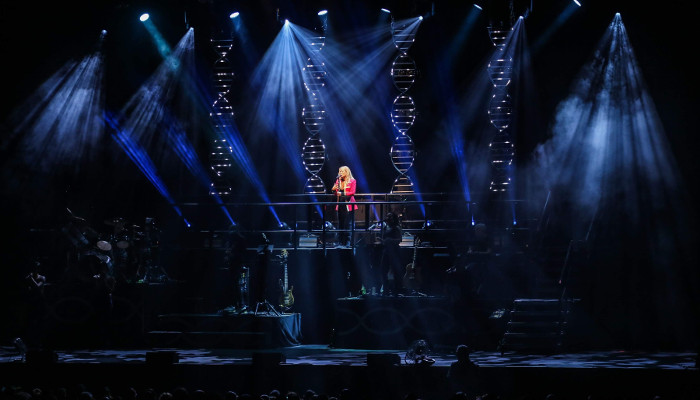
Lighting designers draw their inspiration from a variety of sources. Sometimes it may be the artwork on a client’s album. At others, the spark comes from the lyrics of a hit song. Simon Horn’s captivating design for Anastacia’s Evolution Tour grew out of the name of the tour itself, as is evidenced by the DNA-shaped double helix set pieces that run across the back of the stage.
Like the evolutionary process, Horn’s design has been marvellously adaptive, allowing him to maintain the look of his show as the tour moves through a wide variety of venues, often incorporating house lights into its rig. Key to this flexibility has been his ChamSys MagicQ MQ500 Stadium console.
“We started as a full production tour at theatres and small arena venues, then went to a mix of shows, including multi-band festivals this summer, often working with locally supplied rigs,” said Horn of Purple Lighting (West Sussex, UK). “My MQ500 has been invaluable in terms of making our show very adaptive, without losing its core identity. We always have the DNA-shaped set pieces on the rear of the set flanked in pixel LED tape with two cell blinders mounted to the back.”
Horn credits the easy morphing and cloning features of the MagicQ MQ500 Stadium with helping him adapt his 22-universe show to different venues. “The quick and easy morphing and cloning are an absolute godsend,” he said. “Being able to expand palettes, when being presented with a fixture with extra attributes that I don’t already have programmed in existing palettes and cues, is a massive time-saver. I can use the expand palette feature to push new attributes added to a palette to all cues in the show file that have used said palette
“The same goes for when having only recorded RGB values on an LED fixture in my show,” continued Horn. “If I want to use the amber chip on a new fixture after morphing, as only RGB values were present in the cues, it will only look to reference the RGB values stored in the referenced palette. However, by adding the amber attribute values to a palette and then hitting expand, the amber chip will now be used wherever that palette has been used.
“The MQ500 also makes it easy to morph from a mega point to a normal point, even with effects that previously referenced CMY values, it is very quick and easy to edit colour FX to snap rather than fade between colours and easily change the colour palettes being used by the FX rather than re-recording the FX,” continued Horn. “Even on the fly when I miss something, I can quickly jump in and edit the cue, then just as easily view the upcoming cues and edit them without affecting the current output.”
As flexible as it is adaptive, Horn’s lightshow covers a wide range of moods and looks, from dance solos to soft theatrical moments, to heavy rock with punchy beams, to fun, colourful pop.
“Anastacia describes her show as ‘“Sprock” Soul Pop and Rock,’ so I created a show that defines all these elements,” said Horn. “The DNA towers work well as a backdrop, allowing me to deliver some very vivid looks as well as a starry sky effect for a slow ballad. Those towers go everywhere with us. I designed them so they can be split easily and taken on checked baggage. These took some serious pixel mapping, but I’m in love with the outcome.”