…If you work hard enough and assert yourself, and use your mind and imagination, you can shape the world to your desires.
World-renowned lighting control developer, Anne Valentino, has employed all of the above strategies to establish herself as a leading authority in a field that is not only highly competitive and deeply specialised but is also largely dominated by men. Valentino spoke with ETECH during her recent visit to South Africa about her inspirational journey from a small-town girl to the incomparable leader in lighting control development for the entertainment industry that she has become.
How did you first become involved in entertainment technology?
I grew up in a small town in South Louisiana in the US, which had no arts programming to speak of and I did not encounter the theatre until I started college as a psychology major at the age of 17. During my freshman year, I was too young to go out drinking with the other students, and therefore spent a lot of time in the dorm on the weekends. One evening, a young woman named Holly Hartmann knocked at my door and invited me to join her at the university theatre. A group of students were working on a production of “One Flew Over the Cuckoo’s Nest”, and I was immediately welcomed and put to work on set construction. My father was a shipbuilding engineer and had taught me how to weld, which turned out to be a useful skill as the whole set was constructed out of aluminium.
I instantly fell in love with the culture and ethics of the theatre world. Everything about it spoke to me – the work ethic, the dedication and most importantly the people. I felt as though I had finally found my tribe. It took me about a year to change my major to technical theatre, and I graduated in three years at the age of 20.
How did you start your career in lighting?
After my undergraduate studies, I had no idea how to launch my professional career. My decision-making process was rather capricious in those days, and I decided to attend graduate school in my father’s hometown of Laramie, Wyoming to buy myself a little time. During my two year post-graduate studies at the University of Wyoming, my interest in theatre lighting grew.
Upon leaving graduate school, I still didn’t know how to find a job. I had no professional experience and no idea where to find opportunities. I managed to get some work doing set design and construction for a series of historical symphonic dramas written by Paul Green back in my home state, and finally decided to follow a few friends to Austin Texas. I did what everybody does when you can’t find a job in your field, and waitered tables for a while. While reading through the Austin American Statesman one day, I saw an advert for a technical director at a new theatre complex that was being built in a small town called Orange Texas.

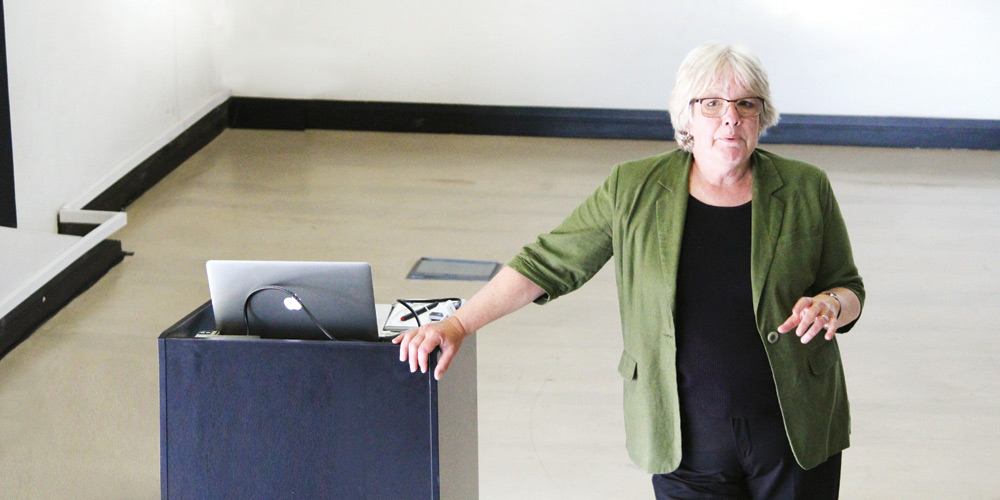
Valentino shares her insight into the development of modern lighting control consoles.

Lighting designers from across Africa attended Anne Valentino’s lecture at the Market Square Auditorium.
I decided to apply and – shockingly enough – I was hired (I think because I would work cheaper than anyone else). I later asked Steve Schulman, who hired me, why he had given me the job, knowing that there were better-qualified candidates who had applied. He responded: ‘It was clear that you were smart, and that you would work hard. Somebody needed to give you a break – and someday, it will be your turn to give someone a break.”
The Orange Texas theatre was brand new, but it was the most poorly consulted theatre I have ever seen. We had electrics that would not fly all the way to the deck because the multi-cable was cut too short, so you had to get up on the scaffolding to hang the rig. It had a hospital intercom system, so only one person could talk at a time. It was the most dysfunctional space imaginable – but we somehow made it work.
When did you start building lighting consoles?
As a result of my frustrating experience as a technical director, I became increasingly interested in the business side of the industry. I wrote a letter outlining my concerns to Joel Rubin, who then served as president of sales for Kliegl, an American equipment manufacturer. We met briefly at a conference in 1982, and he subsequently offered me a job as a technical writer. I, therefore, decided to move to New York and started working with Kleigl and later got involved in product demonstration and training at the company, just as the transition to computerised equipment started to take hold.
Following my time at Kliegl, I took up a position with Crews Folsom doing design and build work for television studios and refitting theatres. While at Crews Folsom, I served as a Strand product representative, and Strand headhunted me as a dimming and control product manager. It was during this time that I started working on my first consoles – the Light Palette 90 and the LightBoard M desk.
Just after launching the Strand consoles, founder and CEO of ETC, Fred Foster offered me a position as a dimming controls product manager. Fred informed me as I arrived, much to my astonishment, that the position has become manager of research and development. Over the years that followed, we worked with David Cunningham on developing ETC’s Sensor dimming system, Source Four fixtures, while also developing the Obsession product line with John Ide.
When did you start to specialise in automated lighting?
Shortly after moving to Los Angeles to work for Strand, I was invited to a big dance show called Solid Gold by a production company called Morpheus. The company was among the first to use automated lighting, and I was very impressed with the technology. I realised that a bullet train of automated lighting was coming that would revolutionise the field – and decided that if I did not learn something about it, I would very quickly become a dinosaur.
Because of that, I felt it was time to leave ETC, as the company only worked in the non-automated realm at that time. I moved back to LA and was working with David Cunningham when Vari-Lite started their architectural lighting division, Bob Dungan called me and offered me a position in the new business unit. At the time, Vari-Lite had the Artisan on the market – but it was getting a bit long in the tooth, and the research and development team were struggling to get started on developing a new console. Bob, therefore, suggested to Vari-Lite co-founder, Rusty Brutsché, that I be moved onto the project, and Michael Snyder and I started work on specifying the Virtuoso console.
Programmers are a critical component in the on-going development of lighting control products. If you refuse to listen to their feedback, preferring to dictate to them based on the premise that you know better, your product will suffer and is unlikely to gain popularity in the market.
When did you start work on the ETC Eos console?
Shortly after starting my own consulting company, Dennis Varian contacted me and asked me to consult on the development of a new desk for ETC – which was to become the Eos. Dennis and I worked for a couple of years figuring out what kind of platform we wanted. We knew that we needed something for the theatrical market because concert touring was very well served. Finally, in 2003, we started actively building the Eos, which we launched in 2006. I continue to work with ETC on the Eos product family and became a permanent employee of the company in 2016.
I have been very blessed with some amazing opportunities over the years. New consoles are not built from the ground up very often, and I have simply been in the right place at the right time when a lot of these projects were launched. I love the work that I do, especially working with our customer base. I enjoy the fact that I work with people who are half my age because they keep me young and push me in ways that I think are good for me.
Has being female affected your career?
Looking back, I don’t recall my gender being a particular issue – certainly not one that I allowed to affect me too deeply. For the most part, if people have an objection to me based on my gender, I choose not to take it personally and acknowledge that it is not my fault or my problem to fix. I look back at the trajectory of my career, and if there is a glass ceiling based on gender, I am not aware of it.
It is, however, difficult to ignore the fact that this industry requires you to be on the road a lot, which can make it difficult for many women to have and maintain a family. There is a biological imperative that women are the ones that have to give birth and who, in the vast majority of cases, are the primary nurturers in the family. Men can do a lot – but they can’t make breast milk.
I made a very personal decision not to get married and not to have children, in part because of the demands of my career. I can honestly say that if I had children, I probably would not have been able to sustain the career path that I have chosen. Not to say that it is impossible, I have a friend in the UK whose partner is a stay-at-home dad, while she has an international lighting design career. It is, however, not usually the case.
Have you encountered gender discrimination at times?
There is one incident that sticks out in my mind as blatant gender discrimination, which occurred when I was the director of research and development at ETC in the 1990s.
I went to PLASA in 1992, and there was a product being launched that I really wanted to see. I kept going into the booth, and nobody would show it to me. I walked out and was kvetching to Keny Whitright, the owner of Wybron, explaining that I could not get these people to talk to me. He walked me back into the booth and, with him standing next to me, there was immediate engagement. The product representative started the demo, and as soon as I asked a question, the rep would direct his answers to Keny – continuing to ignore my presence completely. It was infuriating. Finally, exasperated, Keny took me by the shoulders and physically moved me in front of the rep to try to make the point.
Ironically, Richard Pilbrow put together a PLASA panel on what it is like to be a woman in lighting in 2016. I was joined on the panel by Dawn Chiang, an American lighting designer together with a number of other women with established careers in lighting. During the discussion, a young woman in attendance pointed out that she found it frustrating coming to shows because she was so often dismissed – even though she was a key decision maker in her organisation. I was frustrated to hear this because it meant that no progress had been made, 25 years later.
How has being a woman in a male-dominated environment worked to your advantage?
At the risk of sounding sexist, I think that women are innately better listeners, and this job is all about listening. When you are designing a console, you come with a vision for the final product. If you are lucky, people adapt to it, and they use it. However, many of the programmers that are using the console to make a living have their own ideas and unique needs, and we need to be responsive to that.
Programmers are a critical component in the on-going development of lighting control products. If you refuse to listen to their feedback, preferring to dictate to them based on the premise that you know better, your product will suffer and is unlikely to gain popularity in the market. As a woman, I am very invested in seeking out feedback and responding to what I am told. I have no need to be recognised as ‘an authority’ – preferring to learn every day.
Do you have any advice for young women that are trying to establish themselves in the industry?
I have found that the best approach to adopt when dealing with the select few men that have treated me differently because I am a woman, is simply to ignore it. The best response to gender bias is simply to be the very best that you can be at the job that you choose to do – which the only thing that is ultimately in your control.
I have been very blessed with some amazing opportunities over the years. New consoles are not built from the ground up very often, and I have simply been in the right place at the right time when a lot of these projects were launched.