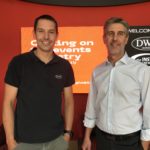
Neal Snyman is one of South Africa’s top recording engineers and producers. Getting his experience early on in London’s Butterfly Studio, he has worked with such international artists as Crowded House, Tom Jones, David Bowie and Bjork. Locally he has engineered and produced such acts as Mango Groove, Springbok Nude Girls, Brenda Fassie, Prime Circle and the Parlotones and from 2000 to 2005 produced the direct-to-broadcast Live on Five sessions from the SABC. His work has garnered three SAMAs for Best Rock album and one SAMA for Best Adult Contemporary Album.
Greg Bester had a chance to shoot the breeze with Neal to find out a little more about him.
Tell me where in South Africa you grew up before moving to London in 1987 and what influenced you during those years to get involved in music, recording and production?
Neal: I grew up in Johannesburg. My dad was involved in the music industry and I’d always accompany him to gigs and recording studios when I wasn’t at school. I was about 12 when I first went to a studio with him and decided that I wanted to be an engineer… or a pro footballer.
Tell me a little about Butterfly Studio. Who did you mentor under and what important revelations did you have there? How influential was your experience there to your recording ethos now?
Neal: The job came about after meeting someone at a different studio while I was doing some programming for a songwriter. She worked for Youth (Martin Glover) who owned Butterfly and said he was looking for new assistant engineer. They had a senior guy in charge who ran the day to day stuff but engineer Chris Potter did all of the heavy lifting – he came in on big jobs which we’d finish at Olympic or Metropolis. He played a huge part in my development and always had time to answer questions and explain.
Butterfly was a crazy place. The bands I worked with went from the ridiculous to the sublime. The gear list was quite modest so we’d always be renting gear in, but we were always looking for new ways to use what we had. We’d manipulate stuff, print it and move on. There was a strong ethic of committing to an idea. No undo buttons. If it didn’t work we’d do it again. Being able to hit undo is great but it does drive me up the wall when artists can’t commit to anything! Youth had a profound impact on the way I look at stuff. He’s an amazing character. My time there served to build a solid platform to work from. I’ve evolved quite a bit since then but the fundamentals remain the same.
You have worked with some big name artists like Tom Jones, David Bowie and Bjork. What do you identify in these artists that South African artists could or should apply to their own work?
Neal: In a vacuum, most artists are alike. They tend to share the same insecurities and/or ego issues. Successful artists, regardless of where they come from, are the ones with a solid work ethic. The essence of what make artists like The Parlotones or David Bowie successful is good management, unrelenting work stamina and letting the people who work for or with them to get on with what they’re good at.
How do you work these days? Do you prefer the sound of analogue, the streamlined workflow of digital or do you implement a hybrid approach? Elaborate on your currently preferred recording and mixing platform.
Neal: Things are changing fast. I don’t think I miss analogue at all these days. A few years ago I would have kicked myself for saying this. I had a hybrid DAW/outboard system for a long time (still do) but work entirely ITB now.
The way people listen to music has pretty much pushed me to favour software over hybrid or analogue setups. MP3, audio streaming via YouTube, soundcloud and heavily limited radio/TV mixes have completely killed any subjective value analogue recording has to offer. People also listen to music differently – iPod head phones, through their phone speakers, in their cars. It’s very rare that punters sit down, put a record on and just listen. Making music has never been easier. Given the tools we now have, recording a band and setting up a good mix it pretty straightforward. The difficult thing is finding a good song.
You have a fantastic drum sound. If you could pick three elements that make a great drum recording, what would they be?
Neal: Care with mic placement, decent drum kit and most of all a good drummer. A fourth element would be a good sounding room.
Your work has won many SAMA awards. What do you think is the secret to a hit album that is hailed by your peers?
Neal: I’ve not personally won any SAMA awards – a few of the bands I’ve worked with have. I’m not sure there is a secret to winning awards. There are many bands out there that should be selling records and winning awards but aren’t.
You recently produced an album for Newton’s 2nd Law of which I am a great fan. The vocals sound really great. What microphone did you use for the lead vocals and what was your processing chain?
Neal: We recorded at the SABC in M3 and I used the Sony C800 that I think I ran through the Focusrite ISA215. The sonic character of the vocal actually comes from the overdrive plugin in Logic.